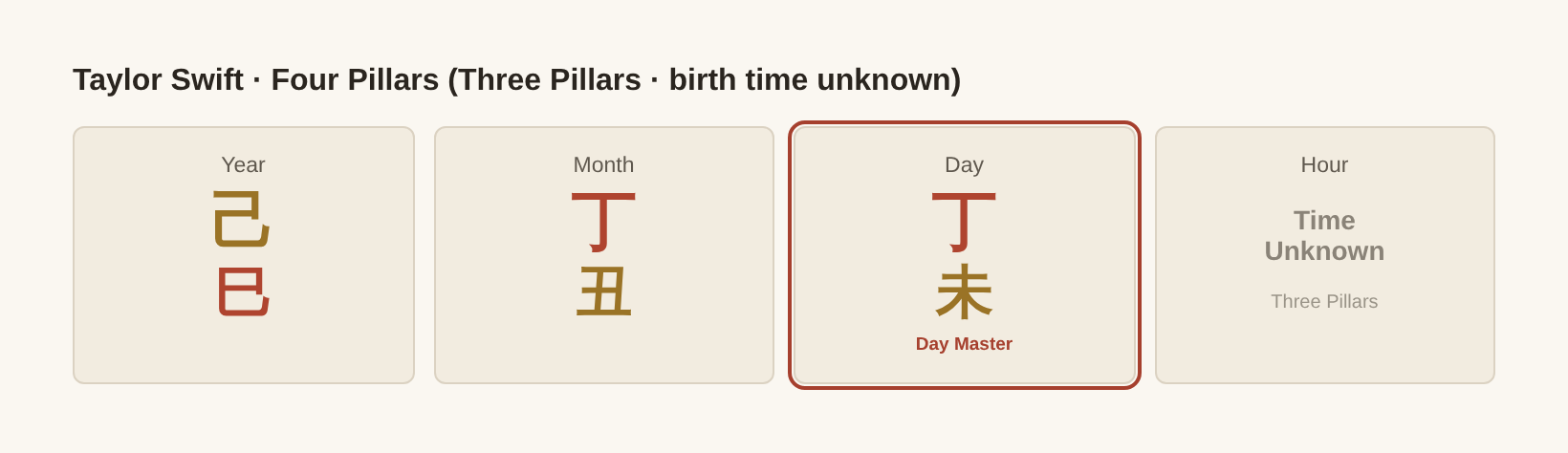
In August 2025, Taylor Swift announced her engagement to NFL player Travis Kelce, and the news lit up the whole world at once (CNN, 2025-08-26). It’s the kind of moment that makes people curious about the person behind the songs. So let’s look at something quieter than the headlines: the chart she was born into on December 13, 1989. Her birth time isn’t public, so we read three of the four pillars — the year, month, and day of her birth, each one a pillar. Even with three, the picture is remarkably clear.
A candle in the dark — her innate core self
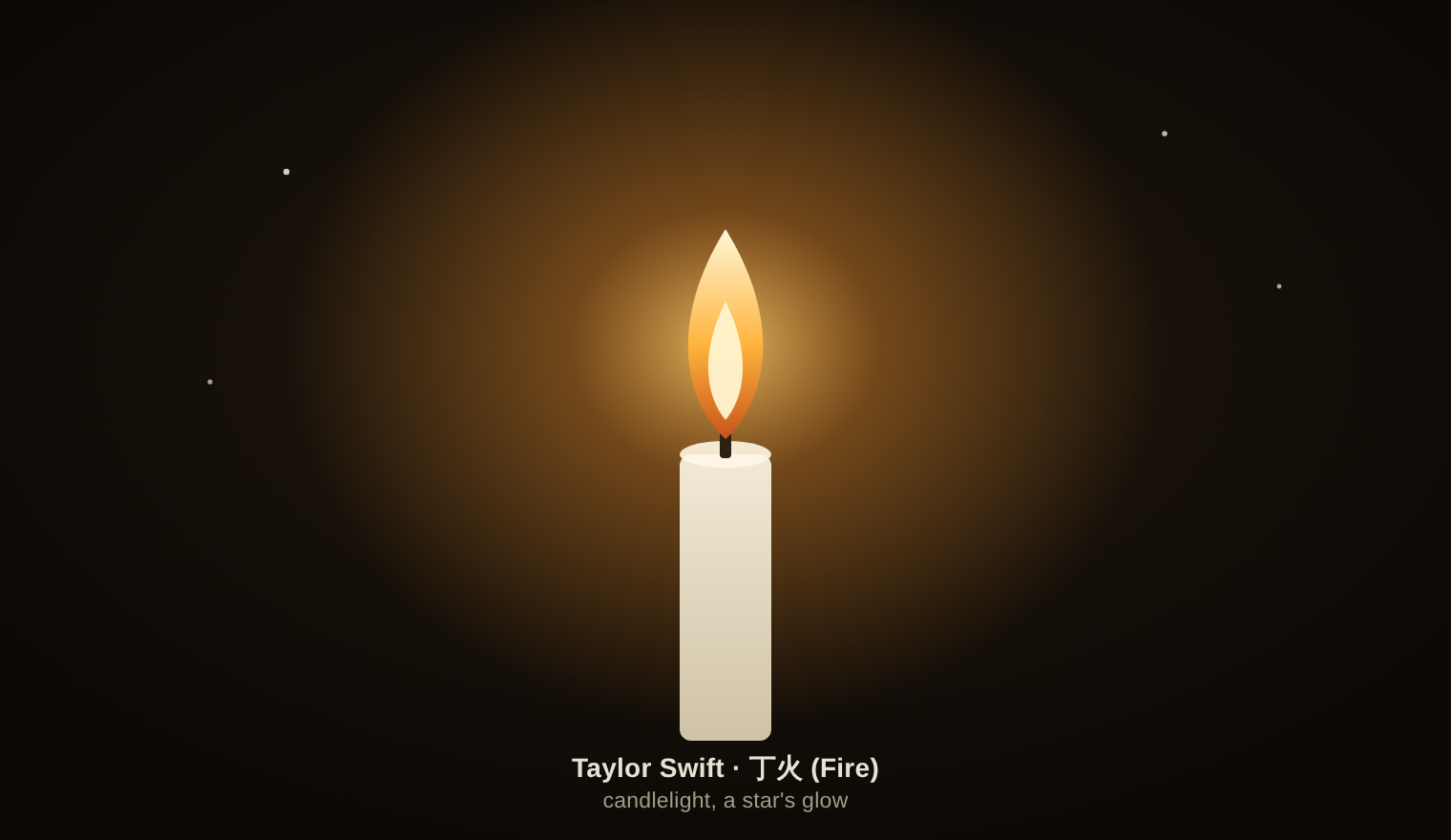
Before anything else, Bazi asks one question: what is the core self at the center of the chart? For Taylor, that center is a quiet Fire — not a bonfire, not the sun, but a candle flame, a star’s glow, the light of a hearth in a dark room. In Bazi this innate core self is called 丁火 (Yin Fire).
Here’s what’s lovely about that image. A candle doesn’t roar. It doesn’t try to light up the entire sky. It gives a steady, certain light in the dark, and it draws people close. Where a big, blazing Fire wants to dominate the whole horizon, a candle wants to illuminate one corner completely — and that difference in temperament is the whole story of this chart. The classics read this core self this way:
- Quiet on the surface, but it gives a definite, unmistakable light — like a candle in the dark.
- An unusual power to burrow deep into one single field.
- Emotional and highly intuitive, with a natural artistic gift.
- An inner fire strong enough that stress often gets swallowed and held inside.
Notice how well the shape fits a songwriter — someone whose whole craft is turning private, interior feeling into a light other people can warm their hands on. A candle’s job is intimacy, not spectacle; it lets you read one page clearly rather than flooding a stadium. The intuition line matters too — this is a core self that senses things before it can explain them, which is exactly the instinct a writer needs to catch a feeling in the air and pin it to a lyric before it slips away.
That last line, though, is the part that’s easy to miss: a candle burns inward too. The same flame that comforts a room can quietly consume the person holding it. An inner fire that is strong enough to swallow stress is a fire that keeps its cost private. That’s not a flaw the chart is warning about — it’s simply the honest other side of a deeply focused, deeply feeling nature. Strength and cost, cut from the same wax.
A stage built for creation — the Output structure
Every chart sets a kind of stage. Taylor’s stage is built for one thing above all: making, expressing, putting something out into the world. In Bazi this is called the 食神格 (Output structure), and honestly, it’s hard to imagine a cleaner label for a singer-songwriter.
Think of the Output structure as the talent for feeding people — literally the gift of cooking, of making, of teaching, of creating something and handing it over. The keywords the tradition attaches are expression, creation, and, charmingly, “good fortune with food.” It’s a chart that is happiest when it is producing something. Not accumulating, not commanding — producing. The joy of this structure is in the act of making the thing and watching someone else receive it.
This is the elegant part. Her core self is a candle — a source of light — and the stage that candle stands on is built to turn that light into something shareable. The instinct to burrow deep into one field meets a structure designed for output. Put those two together and you get a person wired to sit alone in the dark, catch a feeling, and shape it into a thing the whole room can hold.
And here’s why the two halves reinforce each other so neatly. A candle that gives light with no one around is just a candle burning in an empty room. The Output structure is what gives that light a destination — it turns the private glow into a gift someone else can hold. Take away the structure and you’d have a gifted, intuitive Fire with nowhere to put itself. Take away the candle and you’d have a stage with no performer. Together they describe a maker: quiet source, open hand.
The house is full of earth — where all that fire goes
Now let’s look at the balance of the chart, because this is where the story gets interesting. Bazi reads everything through five basic energies — Wood, Fire, Earth, Metal, and Water. In a settled chart you’d like to see a bit of each. Taylor’s chart holds only two of them.
- Fire — about 40%. Her own candle-light, warm and present.
- Earth — about 60%. The dominant weight of the whole chart.
- Wood, Metal, Water — all at 0%. Simply absent.
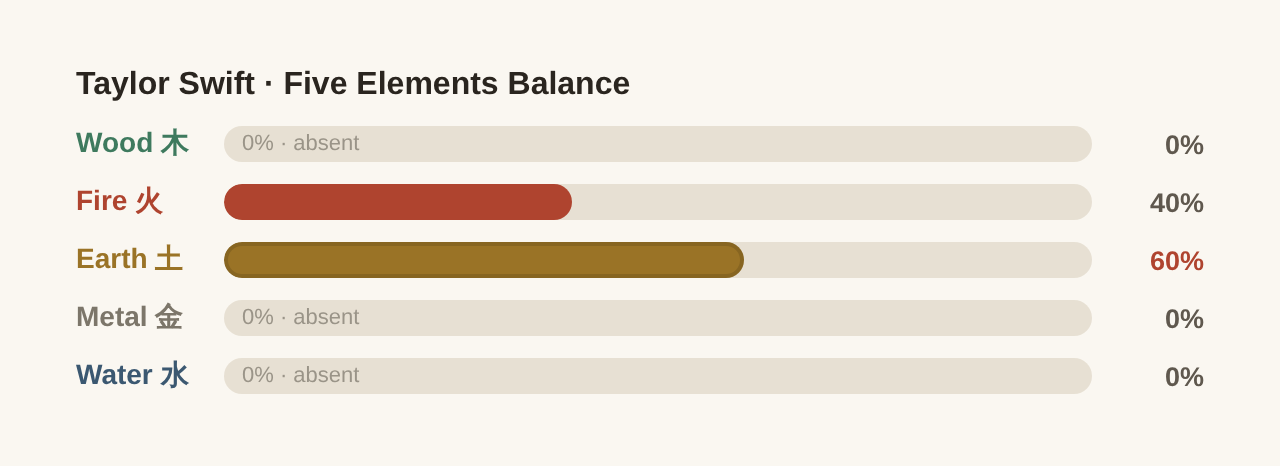
Picture it plainly: a single candle flame standing in a house packed floor to ceiling with earth. Fire feeds earth — that’s just how these energies flow, Fire giving birth to Earth — so almost everything the candle gives off is being poured straight into all that ground. The flame is constantly spending itself. Every bit of warmth it produces gets absorbed by the sheer mass of earth around it.
That’s why the tradition reads this as a chart that runs light on its own reserves — in Bazi, a 身弱 (energy-light chart). And it’s important to be honest about what that phrase means and doesn’t mean. It is not weak as in lesser, or small, or fragile. It’s light as in a flame giving away more than it’s getting back — a candle doing generous, continuous work in a very large, very demanding room. An energy-light chart is often the mark of someone who pours out for a living.
Sit with the empty columns for a second, because absence tells you as much as presence. With Wood, Metal, and Water all sitting at zero, there’s no Water to cool the flame or bring it rest, no Metal near it to be refined by its heat, and no Wood to feed it — except through timing, which we’ll come to. It’s a spare chart, a chart with very few ingredients, which is part of why the picture reads so cleanly: one small light, an enormous house of earth to warm, and not much else in the room.
The medicine this chart has been missing
So what does a candle-in-a-house-of-earth actually need? Bazi answers with two ideas: the element that acts as medicine, and the element that acts as poison.
For Taylor, the medicine — the Useful God — is Earth. That may sound strange when Earth already dominates the whole chart. But remember the Output structure: this is a chart built to give, to make, to pour out. Earth is exactly what receives all that Fire and turns it into something. The medicine here isn’t about calming the person down; it’s about having somewhere for the creation to land. A candle with nothing to warm is just wasting itself in the air — Earth is the room, the hearth, the thing that makes the burning mean something.
Right behind it, Metal is the supporting helper — the element that would give the output its shape and edge. And here you can see how the tradition weaves the whole thing together: Fire controls Metal, Fire shaping and refining it, so a bit of Metal would be the raw material this flame is actually built to work on. Earth to receive, Metal to shape — that’s the healthy circuit this chart is reaching for.
And the poison — the element that works against her — is Wood. Here’s why that’s counterintuitive but important. Wood feeds Fire; Wood gives birth to Fire. More Wood means a bigger, hotter, more restless flame in a chart that is already giving away everything it has. For a light that’s running lean, being made to burn even brighter isn’t a gift — it’s a drain. That’s the quiet caution folded into this chart: not everything that makes the flame bigger is good for the candle. Sometimes the thing that looks like fuel is really just faster burning.
I find that reversal genuinely beautiful, and quietly wise. We tend to assume more energy, more intensity, more fire is always the win. This chart says the opposite for its own wax — that a candle’s real friend isn’t more flame, it’s a place to shine and a thing to shape. Reserves matter more than blaze.
The ‘Adjustment’ season she’s living in now
The last layer is timing. In Bazi, life moves through seasons that change roughly every ten years — long chapters that color the weather around a chart without changing the chart itself. From around 37 to 46, Taylor is inside a stretch the tradition literally names the ‘Adjustment’ season (庚辰).
An Adjustment season is a recalibration — a chapter for realigning, for settling things into a firmer shape rather than chasing more heat. Given a chart that is one candle spending itself in a house of earth, a season named for steadying and grounding is a fitting place to be. It’s the difference between burning brighter and burning steadier — and for a flame that runs light on reserves, steadier is the kinder direction.
Read alongside everything above, there’s a pleasing rhyme here. A chart whose medicine is grounding and receiving, moving through a season named for adjustment and settling. I won’t pretend the chart predicts a wedding, a marriage, or any single event — it doesn’t, and that’s not how any of this works. A chart describes the material a person is made of; what she builds with it belongs to her and to the world, not to the stars. But it is quietly fitting that a light designed to give itself away is standing in a season built for grounding, right as she steps into something new.
What a candle teaches the rest of us
Here’s the part I keep coming back to. The strongest thing about this chart isn’t a roaring, sun-sized fire. It’s a small, certain flame with the discipline to burrow into one thing, the intuition to feel it before it can be named, and the structure to turn that feeling into something you can hold. Quiet source, open hand. If you were designing a chart for a person who writes songs, you’d have a hard time drawing a truer one.
And the catch is written into the very same chart, in the same handwriting — the flame that warms a room can quietly consume itself; the energy that pours out needs a hearth to land on, not more heat to chase. Strength and cost, side by side, honestly declared. That refusal to flatter is exactly why Bazi is worth reading at all. It doesn’t tell you you’re limitless. It tells you what you’re made of, and where your candle needs shelter.
This is only a sample — the structure, summarized from three pillars, with the birth hour left as a blank. Your own chart is the entire thing, read line by line, 1:1 (DukStack). If a single candle in a house of earth can say this much, imagine what your own flame, in your own house, has been quietly saying all along.
Sources · CNN · CNN · Wikipedia/Britannica